For making a phone call, there are two major reasons. The first reason is information exchange - and speech, as mobile phones in their current form enable it, is well-suited for that. The second reason, however, is a need for nearness - it is the need for being in touch. To explore this field, we developed three prototypes that investigate future visions of physically being in touch through mobile phones.
We propose three new channels of communication for mobile phones – tightness, moisture and airflow. All means are explored through mobile phone-shaped and -sized boxes, which are equipped with the necessary actuators.
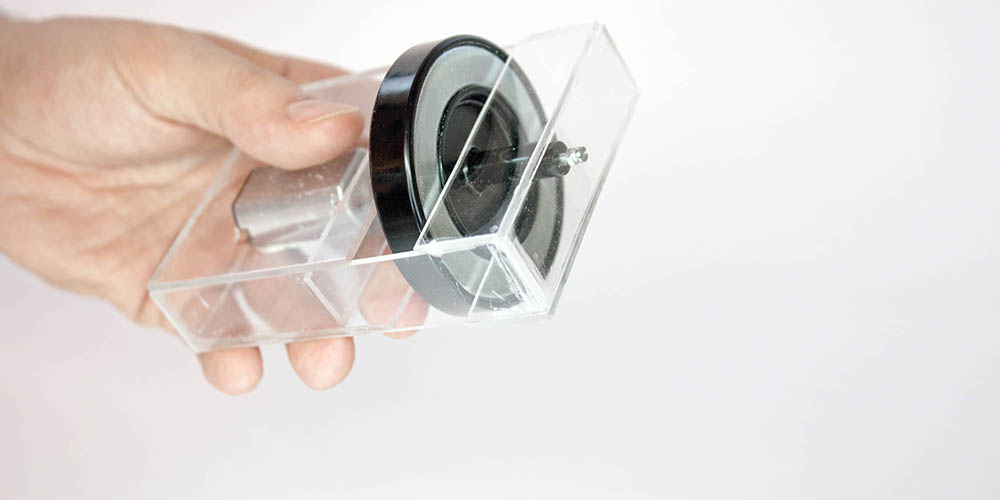
The 'grasping mobile' is equipped with a motor on its inside that allows for a widening loop to be extended and pulled towards the mobile phone’s back side. This loop can be placed around the user’s hand, allowing for an actuation of tightness.

For instance, this system enables users to telecommunicate through hand grasp while talking. Through force sensors on the phone's sides the grasp's intensity can be sensed, and is then reproduced by the loop around the other user's hand. The system also allows for drop prevention through software-controlled adhesiveness. For instance, the phone can be affixed to the user’s hand while engaging in bodily activities, while making privacy-critical actions, or while playing a game that requires movements of the phone.
The 'crying phone' is an investigation into moisture as a means of interaction in mobile phones. It is equipped with a semipermeable membrane and a motorized sponge that can be pressed against the membrane.

The sponge is connected to a nearby water pump, and a moisture sensor on the phone's front side serves as the corresponding input. The system allows for the usage of liquids as an interactive means, and also can telecommunicate a kiss over a distance.
This prototype - the 'whispering phone' - is equipped with a set of air jets, allowing for a different types of air stream output. The jets allow for the reproduction of the caller’s nostril airstreams and for the air involved in speech (including guttural and plosive sounds).

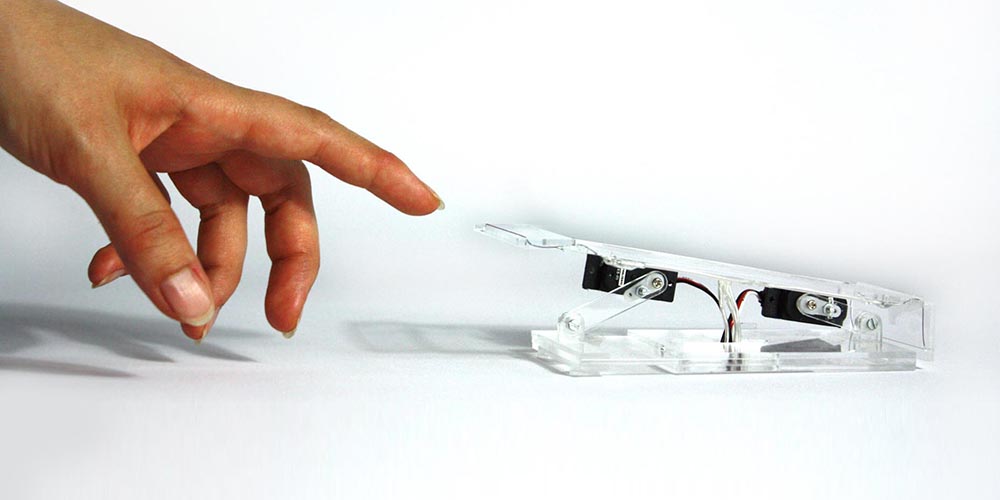
The air jet can also be used as a system for tactile feedback, to reject the user’s finger (e.g. when performing a critical action, such as deleting a file or contact) or to attract the user’s finger (e.g. as a guide towards an action that is recommended, such as confirming a default setting).
Combined with the phone's microphone, to serve as a distance sensor for the user’s finger with active haptic feedback.